

The Slush Scam
The literary agent as scammer
Show, don’t tell. Write what you know. Write drunk, edit sober. To this list of overused writing cliches, let’s add that most violent bon mot of them all: kill your darlings. This was very hard advice for me to follow while writing Middlemen: Literary Agents and the Making of American Fiction, not least because I’m dispositionally inclined to find most things interesting and because I was digging through the history of a profession filled with Real Characters.™
How could I possibly cut the story of Diarmuid Russell and Henry Volkening, agency partners who, after a disagreement over a client, didn’t speak to one another for years and communicated agency business only through petty little note?
How could I cut the description of Harriet Wasserman’s one-night-stand with her client Saul Bellow? (Including her colorful descriptions of trying to extricate herself from the black bodysuit that she was wearing.)
What to do with the fond letters between F. Scott Fitzgerald and his agent, Harold Ober? The Obers and the Fitzgeralds were so close that Ober and his wife became the legal guardians of Scottie after Scott and Zelda died.
How could I capture the shock that I experienced when reading through Parisian agent Jenny Bradley’s letters to her American client Margaret Mitchell, that ended abruptly mid-conversation when Mitchell was killed in a car accident? (I gasped so loud enough to disturb other researchers in the Ransom Center’s reading room.) Or the outrage that I felt when reading Gertrude Stein’s unhinged letter to her agent William Bradley, accusing him of mismanagement and firing him, fresh off of the international success of The Autobiography of Alice B. Toklas?
Many, many darlings were killed in the making of Middlemen.
One of the most colorful characters that I came across in researching this book was literary agent Scott Meredith, credited with inventing the book auction. Meredith makes a brief appearance in Chapter One: The Pitch, for the auction fundamentally rearranged American publishing, establishing agents as the industry’s central, most powerful figure. The kind folks at LitHub let me resuscitate this little darling and go long on the (probably apocryphal) story of the first book auction last week. While working on the piece, editor Emily Firetog shared my dilemma— how could we possibly cut anything about Meredith? But cut I did.
I did not publish, for instance, that Meredith— one part literary agent and at least two-parts con artist— was also (according to his former employee, Barry Malzberg) being investigated by the FBI for running a small pornography distribution operation under an assumed name, forwarding obscene literature from its producer to its publisher through the mail. But, oh, how I wanted to.
Instead, I published the story of how Meredith inadvertently created an auction by sending the same manuscript to several publishers at once, when custom dictated he proceed one-at-a-time. This was possible, in part, because the Scott Meredith Literary Agency was flush with cash— they could afford to hire multiple typists to produce multiple copies of the manuscript. The agency’s financial stability came from the petty scams Meredith ran through the agency, including charging a reading fee for his personalized feedback on potential manuscripts. I wrote for LitHub,
Aspiring writers could submit their manuscript to the Scott Meredith Literary Agency—for a fee. For the low price of $10-a-novel in 1946, Scott Meredith would reply with his personalized assessment of the work’s promise. Some lucky writers would be invited to continue to correspond with Meredith to further develop their manuscript, paying for each revision in the hopes of signing with the great agent eventually. […] Though it raked in profit, the reading fee scheme was never very successful at surfacing promising clients. He received— and rejected— manuscripts from Stephen King and Raymond Carver.
The fee scheme received significant attention— and criticism— during its day. Literary agenting has been especially susceptible to scammers since its the profession’s inception. In pre-internet days, writers had to trust an agent sight unseen, based only on their advertisements and easily falsified bona fides, not unlike the scammy emails that are still being sent to aspiring writers that agencies must continually disavow. Then, as now, legitimate agents separated themselves from scammers by refusing to accept readers fees. (This precept is so foundational that it was one of the first inscribed in the Association of Author Representatives— now AALA— charters.) A real agent only makes money when the client makes money; a real agent would never accept a fee for their work.
Though the fee scheme was an open secret in the industry, it was publicly uncovered in 1986, when journalist Joe Queenan profiled the agent in The New Republic. By then, the fee for a manuscript had rocketed from $10 (in 1946) to $250. (Forbes reported that the agency brought in $800,000 from reading fees alone in 1981.) The reading fee was less offensive to Queenan and his sources than Meredith’s aggression: why did have to be so brazen in his pursuit of aspiring writers? The mailers that the agency sent out (to writers whose addresses were secured by creative, but ill-gotten means), touted the agency’s “particular specialty of securing first sales for new writers.” The mailer (photo below) includes photocopies of dozens of “royalty checks” allegedly secured by Meredith.
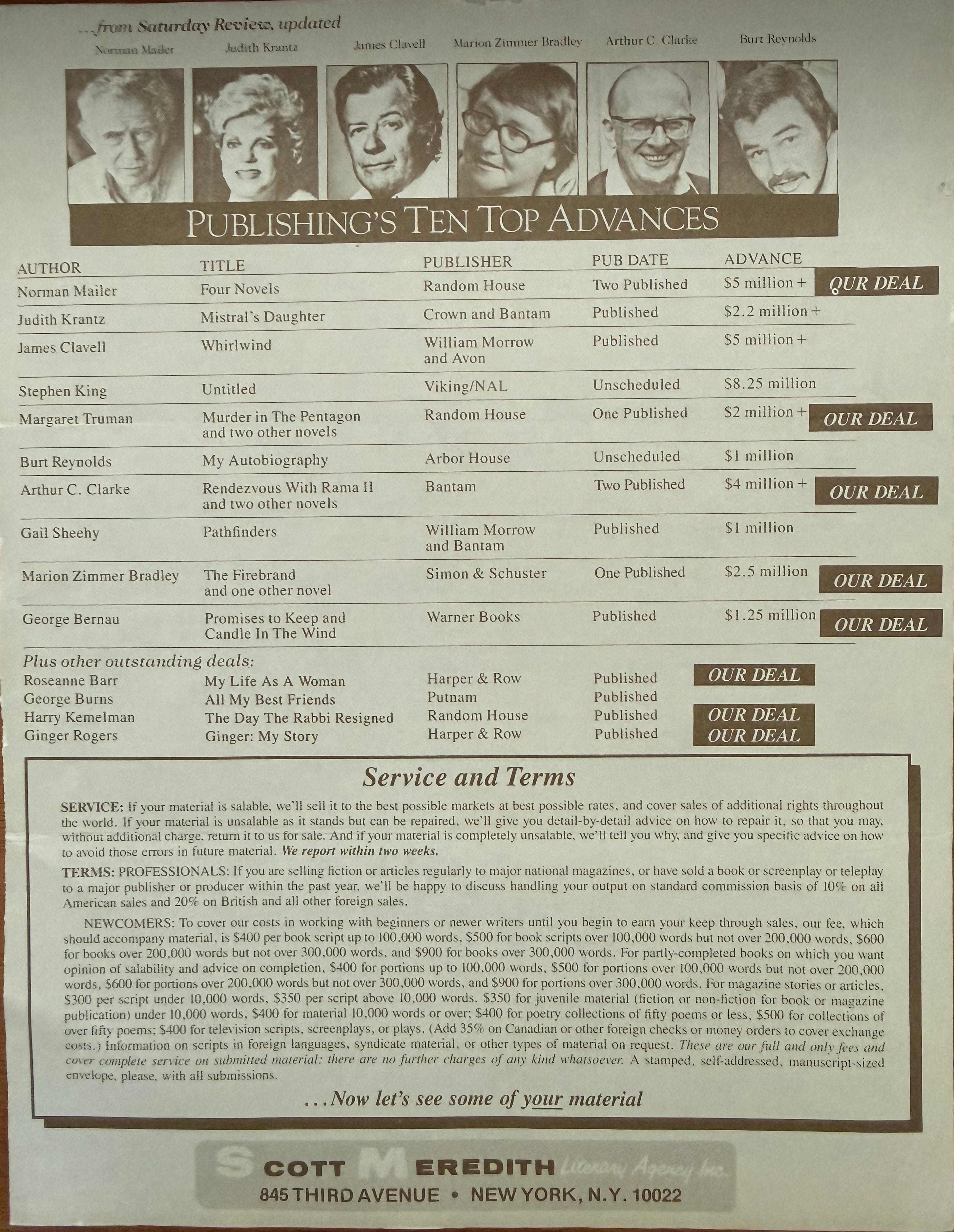
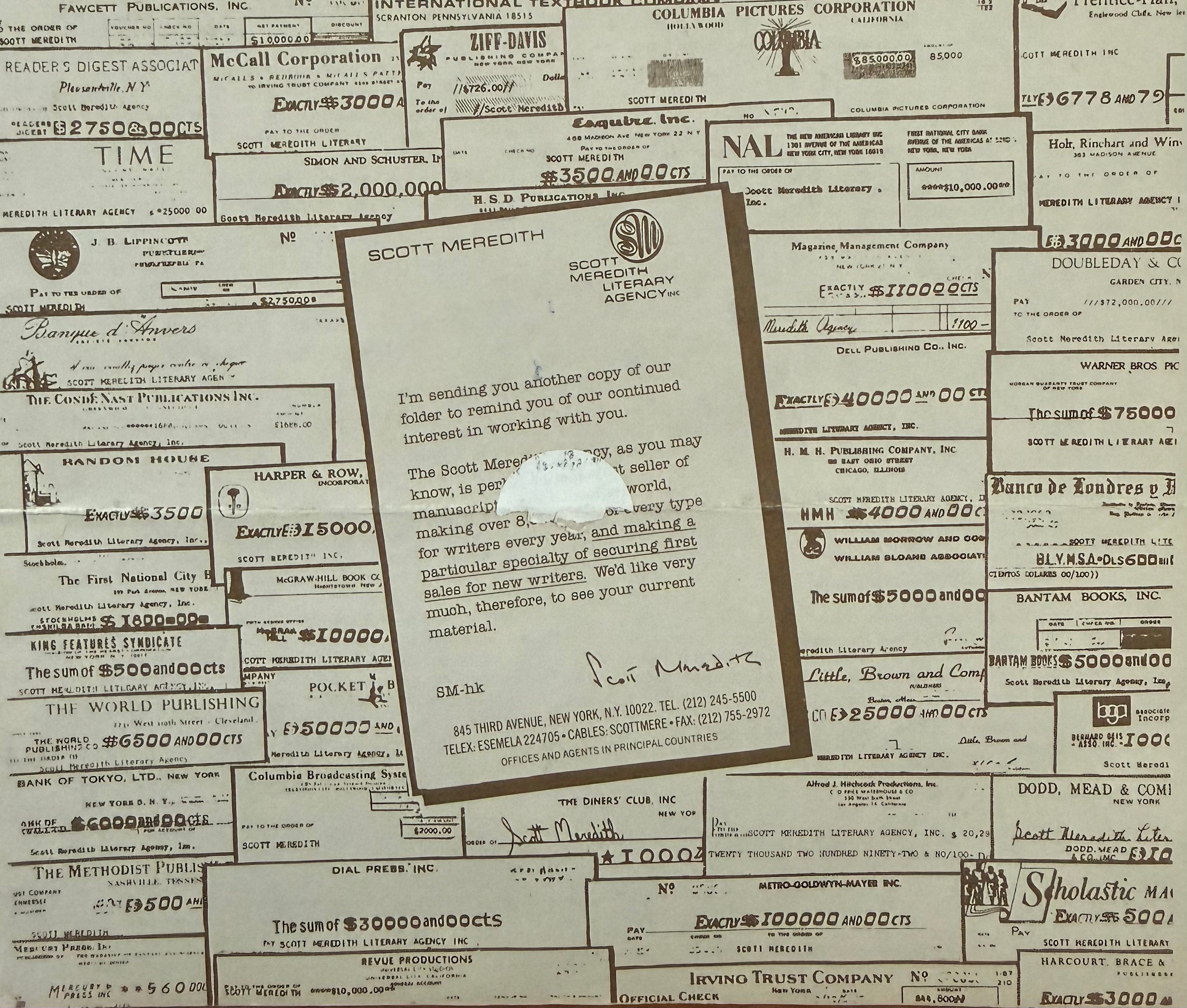
And there were other questions about the legitimacy of Meredith’s money-making slush pile. “Despite Meredith’s legitimate argument that a handful of the thousands of manuscripts his readers pore over every year do actually make it into print, there has been widespread suspicion that if you send him a proposal, he’ll write back and tell you that it sounds publishable, no matter how moronic the subject, the treatment, or the letter you send.” Queenan decided to put Meredith to the test.
Using false names and addresses, Queenan wrote “three of the most inane book proposals I could think of” and a standard query letter. They received positive reads. “Your novel Bikers from Borneo sounds very interesting, and we would most certainly be interested in considering it for publication.” Queenan declined the next step— to actually submit the full manuscript and an additional $250. But he did get a hold of some of the reader reports that were sent back to writers, all between 4-12 pages, written “in a byzantinely ingenious way so that the obviously tanlentless writer comes away temporarily stymied in his quest for glory, but nonetheless convinced that fame and fortune await him further down the road.” Provided, of course, that he continues to work with “Scott Meredith” (read: one of the editors who wrote the letter and signed his name to it), and to pay for the privilege.
“This long, ambitious novel of the Merchant Marine… is so interesting, so complex, such a jumble of the good, the bad, the indifferent, the audacious, the brilliant, the inept, the workable, the unworkable that I barely know where to start; you’re a brilliantly promising writer, Mr. Taylor, also one who is desperately unfinished and unpolished.”
It’s a sort of paint-by-numbers critique, with the name and the novel’s premise easily swapped out.In fact, not long after Queenan’s story was published, another writer recognized the critique— she had received a very nearly identical critique herself.
Gayle Herman-Zegar was an attorney living in Santa Monica who quit her day job (oh, Gayle) to begin writing a mystery novel called The Poison Pen (dear, dear Gayle). It was 250,000 words long (dammit, Gayle). She sent it to the Scott Meredith Literary agency, along with $400. “It was a lot of money,” Herman-Zegar told the Los Angeles Times, “but it sounded like I’d get a lot for it. They say they’re going to stay with you, revise, work with you.” She received an 8-page reader report, but was crushed by the assessment. That is, until a few weeks later, when she read Queenan’s article in The New Republic.
Herman-Zegar was shocked to read the report for the “Merchant Marine” novel, for it bore a striking resemblance to the feedback she’d received about The Poison Pen. “There’s a great deal to say about this long, ambitious novel full of anguish, coincidence, contrivance and blood, darkness and susceptibility,” her report read. She explained to the Los Angeles Times, “So much of the critique is a form letter with the same adjectives as The New Republic article, I wonder if someone didn’t just skim a few parts and plug in comments to make it sound like they read it.”
Confronted with this evidence, Meredith defended the scheme. And he wasn’t alone, he protested. Agents are expected to do so much reading for free, he argued, that the would lose money if they did not charge— and they certainly would have no time to look after their existing clients. Literary Marketplace showed that 1 in 8 agents charged reading fees, at the time. But unlike the book auction that he is credited with inventing, the pay-per-critique system did not catch on.
Agents are such a useful lens through which to view the publishing industry because they sit at its very center. They’re gatekeepers, yes, but they’re also the chain’s central link, the network’s switchboard, the river’s dam, the bottle’s neck. This is why agents are often impersonated in literary scams: they’re the most crucial point in the process, for an aspiring writer, and the point at which the writer is the most sensitive, the most vulnerable to exploitation. And because real agents routinely reaching out to clients of interest, it’s not implausible to think that an agent might reach out, out of the blue! Being discovered! It’s the stuff literary Cinderella stories are made of. (Yet another cliché!)
As the Scott Meredith story shows us, there is often a fine line between scamming and innovating. Some scams, like the auction, are ultimately vindicated, deemed ingenious by literary historians, transforming the field and literature as we know it. But most others turn back into pumpkins at midnight.
This is amazing! Cant believe you left this on the cutting room floor. You probably know this already but Harriet Wasserman went nuts after Saul Bellow got poached by Wylie—she started stealing from her clients and her agency eventually collapsed.
Wait, you're not supposed to be running small pornography distribution rings on the side? Crap