

Literary Force Extraordinary
How Jenny Bradley Saved Ulysses from Obscurity
Happy Bloomsday, to all who celebrate! In celebration of this most auspicious of literary holidays, allow me to introduce you to the unsung hero of Ulysses.
On December 11, 1960, in the sumptuous Sunday edition of the New York Times Book Review is a photograph of a stately woman. She is dressed handsomely, wearing a handsome three-strand pearl necklace, coordinating brooch, and a dress of rich fabric. She stands in a library, in front of a bookcase. Shot from below, she cuts an imposing figure: she is broad-shouldered with a strong nose and jaw, gazing into the middle distance with a restrained smile on her face. And, at her right hand, perched atop a Louis XIV armchair, is a little cat.
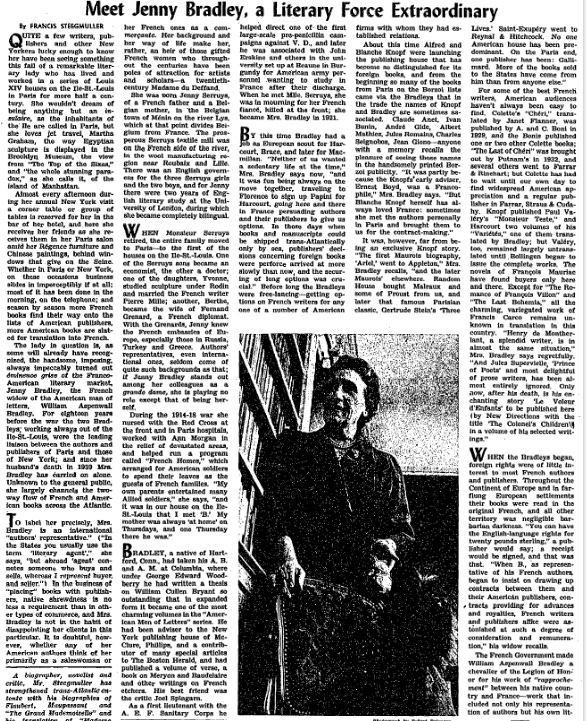
“MEET JENNY BRADLEY, LITERARY FORCE EXTRAORDINARY,” the headline reads. It is the sort of article that one might expect to find in the Society pages, detailing the comings-and-goings of the social and literary elite— not in the Times Sunday Book Review, appearing alongside a review of a new biography of Buffalo Bill Cody and a new history about US presidential transitions. This unknown but nonetheless influential literary figure had travelled from Paris to New York, and the occasion was newsworthy enough to command a two-page spread. “Quite a few writers, publishers and other New Yorkers lucky enough to know her have been seeing something this fall of a remarkable literary lady who has lived and worked in a series of Louis XIV houses on the Ile-St.-Louis in Paris for more than half a century. She wouldn’t dream of being anything but an insulaire, as the inhabitants of the Ile are called in Paris,” wrote the noted biographer and Flaubert scholar Francis Steegmuller. This “remarkable literary lady” and “literary force” had written no books of her own. She was a literary agent.
It’s no surprise that the general public of 1960 would not know of this “éminence grise of the Franco-American literary market,” or even imagine the figures facilitating international publication. Yet it is no exaggeration to say that modernism depended on Jenny Bradley. High on post-war ambition and post-wedding bliss, Jenny and her husband William founded the first literary agency in Paris in 1923. To the Bradleys, an agency seemed only natural: William had been an American journalist, and was already scouting for American publishers in France. Jenny, born in Belgium, educated in London, and raised in Paris, was already translating French literature into English, already a patron of the arts. She hosted a weekly salon, rivaling Natalie Barney’s. Their apartment on the Ile-St.-Louis, the larger of two islands in the Seine, was already bustling with writers like Rainer Maria Rilke, Gertrude Stein, the Fitzgeralds. Paris was overflowing with self-imposed exiles from the United States, desperate to make their living by writing. And so the Bradleys became the agents to the writers that Stein, their client, would famously call “a lost generation,” and became instrumental in the development of American modernist literature.
Though she didn’t represent James Joyce, Jenny played an instrumental role in the publication of Ulysses. James Joyce traveled to Paris in 1920, with a copy of his manuscript and a letter of introduction from Ezra Pound. The writer was at work on a new book, and he planned to finish it in Paris. Of course, he planned to stop at the Bradley’s salon in the Ile St Louis. But, as he arrived at Gare du Lyon, his luggage was nowhere to be found. Ulysses was lost. Despairing, Joyce called upon Jenny for help, and she attended to him immediately. Calmly and competently, she located Joyce’s luggage, averting disaster and reuniting Joyce with his masterpiece. (Though she found the lost manuscript for him, she declined when Joyce asked her to translate it.)
What does “finding luggage” amount to, in the grand narratives of literary history? How do we acknowledge literature’s debt to Jenny Bradley— to the agents, scouts, patrons, collectors, and hosts who created the conditions for literary community to flourish? William and Jenny Bradley were not writers, though Jenny translated. In most cases, they were not even authors’ primary representatives, but handled French translations alone. Their agency would grow to become the central hub in Franco-American publishing, the waystation for all American literary imports and all French literary exports. While William handled the business of the agency (before his sudden death in 1934), Jenny handled its creative direction with her impeccable taste. She introduced a generation of American writers to French reading audiences, and a generation of French thinkers to the American public. In France, the Bradleys represented American writers like Stein, Alice B. Toklas, Henry Miller, Anaïs Nin, Langston Hughes, Claude McKay, James Baldwin, and Margaret Mitchell, among others. And to the US, the Bradleys sent French writers and intellectuals for publication in the United States. Thanks to her especially close relationship with Blanche Knopf, Bradley was responsible for bringing the work of Simone de Beauvoir and Albert Camus, among others, to American readers. And though Jenny was unknown to American readers in 1960, let alone 2025, her unacknowledged support of writers in France created the conditions for modernism’s efflorescence, and some of the most significant literary and philosophical developments of the twentieth-century.
Jenny Bradley isn’t often named among the group of Ulysses’ supporters. There was no mention of her in 2022, when we were all celebrating Ulysses’ 100th birthday.But it is thanks to her that the manuscript was not lost forever somewhere in the Gare du Lyon, that we had a book to read and celebrate. Tonight, I’ll read Molly Bloom’s monologue and drink some whiskey to celebrate my favorite novel. But I’ll be thinking of Jenny Bradley.1

Much of what I know about Jenny Bradley comes from a fantastic book by Laurence Cossu-Beaumont, Deux agents littéraires dans le siècle américain: William et Jenny Bradley, passeurs culturels transatlantiques. Unfortunately, this tremendous book has not been translated into English. She plays a small role in Laura Claridge’s biography of Blanche Knopf, The Lady with the Borzoi. I’m also grateful to the William A. Bradley Literary Agency archive at the Harry Ransom Center at UT-Austin.